
About the Work
Ben Osawe
Ebony, 1997
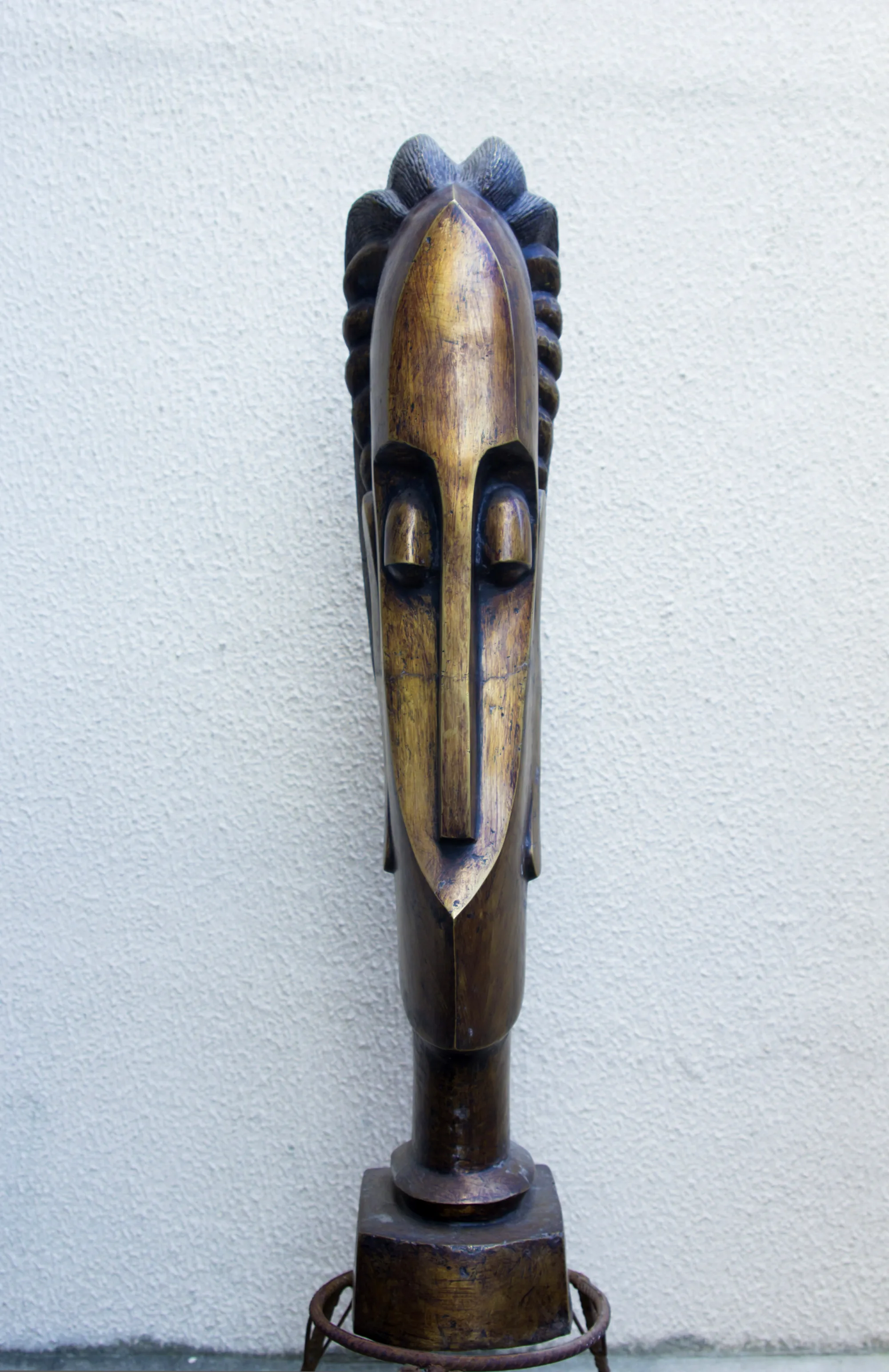
**Ebony (1997)** *Ben Osawe* Executed in bronze cast, *Ebony* presents a sculptural figure with a refined facial structure, subtly suggesting a feminine presence accentuated by a small earring detail. The work reflects a strong emphasis on form, surface treatment, and quiet expression, characteristic of the artist’s sculptural approach. Measuring 30 inches, this 1977 piece by Ben Osawe carries a timeless and dignified presence, emphasizing material strength and classical sculptural balance.
Purchase ArtworkAbout the Artist
Ben Osawe
1931 – 2007
<p>Hails from Agbor, Delta State, Nigeria, undoubtedly one of the most outstanding sculptors in the contemporary artworld. Like several of his pee... <p>Hails from Agbor, Delta State, Nigeria, undoubtedly one of the most outstanding sculptors in the contemporary artworld. Like several of his peers, Osawe brought traditional Nigerian influences together with the formal language of European classical modernism; his motifs came from his African surroundings, while his style is more European. His first instructor was his father, who was a sculptor for Oba Eweka II of Benin. From 1956-59 he studied at the School of Graphic Art at the Camberwell School of Arts and Crafts, England. Thereafter, he returned to Nigeria, where he taught at the University of Nsukka. Right after his training at Camberwell, Osawe committed to using drawing to conceive of forms that would eventually be rendered as sculpture, the medium for which he is arguably best known. Osawe’s works have been shown in many exhibitions in Europe, Africa and the USA such as The Short Century, curated by Okwui Enwezor. In 1962 he took part in an exhibition of the Artists´ International Association in London, and a year later some of his works were shown in the Royal Scottish Museum in Edinburgh. His works are widely exhibited the world over. His Sculptures adorn many public spaces and museums, locally and internationally including the National Gallery of Modern Art in Lagos and the cultural department of the Nigerian Ministry of Information.</p>
Ben Osawe
Ebony, 1997
**Ebony (1997)** *Ben Osawe* Executed in bronze cast, *Ebony* presents a sculptural figure with a refined facial structure, subtly suggesting a feminine presence accentuated by a small earring detail. The work reflects a strong emphasis on form, surface treatment, and quiet expression, characteristic of the artist’s sculptural approach. Measuring 30 inches, this 1977 piece by Ben Osawe carries a timeless and dignified presence, emphasizing material strength and classical sculptural balance.
Purchase ArtworkAbout the Work
About the Artist
Ben Osawe
1931 – 2007
<p>Hails from Agbor, Delta State, Nigeria, undoubtedly one of the most outstanding sculptors in the... <p>Hails from Agbor, Delta State, Nigeria, undoubtedly one of the most outstanding sculptors in the contemporary artworld. Like several of his peers, Osawe brought traditional Nigerian influences together with the formal language of European classical modernism; his motifs came from his African surroundings, while his style is more European. His first instructor was his father, who was a sculptor for Oba Eweka II of Benin. From 1956-59 he studied at the School of Graphic Art at the Camberwell School of Arts and Crafts, England. Thereafter, he returned to Nigeria, where he taught at the University of Nsukka. Right after his training at Camberwell, Osawe committed to using drawing to conceive of forms that would eventually be rendered as sculpture, the medium for which he is arguably best known. Osawe’s works have been shown in many exhibitions in Europe, Africa and the USA such as The Short Century, curated by Okwui Enwezor. In 1962 he took part in an exhibition of the Artists´ International Association in London, and a year later some of his works were shown in the Royal Scottish Museum in Edinburgh. His works are widely exhibited the world over. His Sculptures adorn many public spaces and museums, locally and internationally including the National Gallery of Modern Art in Lagos and the cultural department of the Nigerian Ministry of Information.</p>
More from Ben Osawe